
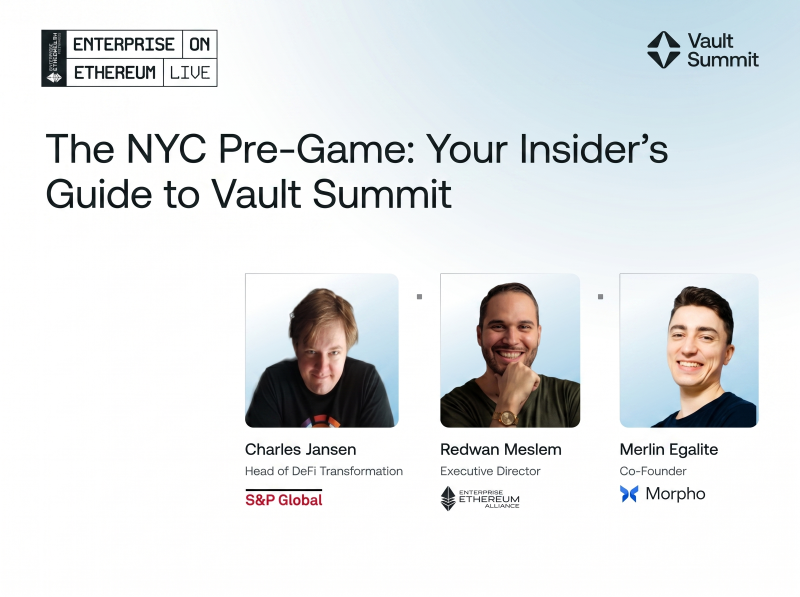
At our third Enterprise on Ethereum Live session, the EEA convened key architects bridging decentralized financial networks and global credit systems. Moderated by Redwan Meslem from the EEA, the panel welcomed Merlin Egalité (Co-Founder of Morpho) and Charles Jansen (Managing Director, Head of DeFi Transformation at S&P Global) to discuss an imminent transformation in institutional asset management.
Broadcast ahead of the upcoming Vault Summit New York, co-hosted by Morpho and S&P Global at the New York Stock Exchange (NYSE), the discussion laid bare why institutional interest has shifted decisively toward isolated risk modeling and customizable onchain wrappers. Just as the ETF disrupted the mutual fund market decades ago, programmable onchain vaults are structurally positioned to reshape the future of institutional portfolio design.
Shifting From Pooled Risks to Isolated Vault Infrastructures
Early decentralized lending iterations relied heavily on unified liquidity pools. While this setup provided simple user experiences for trading, it introduced severe systemic vulnerabilities. If a single asset in a pooled protocol suffered an exploit or an oracle malfunction, the entire pool’s capital was compromised.
To bridge the gap between traditional capital markets and decentralized protocols, the industry has completely re-engineered its backend architecture. By separating the market accounting layer from the active risk management layer, infrastructure providers can now isolate threats seamlessly.
“If you pull everything together… if one asset blows up, everyone is exposed to that… We realized that three years ago when building on lending pools, and we decided: if we really want to scale the DeFi space and bring more institutions, finteches, and new entities into that space, we need to isolate the risk.” — Merlin Egalite, Morpho
Under this isolated framework, risks are externalized to distinct, non-custodial smart contract containers—or vaults. Independent risk curators manage these vaults separately, allowing institutions and fintech firms to select their exact parameters, collateral rules, and risk tolerances top-to-bottom. A single firm can simultaneously operate a conservative, low-yield treasury vault alongside higher-risk products tailored to specific customer profiles.
Institutional Demand for Risk-Rated Onchain Products
The baseline appetite for onchain yield has expanded far beyond crypto-native assets. Major traditional credit instruments, tokenized money market funds, and asset-backed debt products are moving onchain rapidly. However, a key bottleneck preventing scaled asset manager participation has been the complete absence of visible, standardized risk-assessment frameworks.
Traditional institutions are eager to put capital to work, but compliance and risk departments require trusted, third-party evaluations before entering automated environments. S&P Global’s strategic expansion into digital assets—including stablecoin sustainability assessments and private tokenized money market ratings—directly targets this operational friction.
“You have this S&P 500 available now on Morpho, tokenized with Centrifuge… I can have an exposure to the price of the S&P 500 and I can get an extra yield on it. That’s great. But something that nobody can really answer right now is: what is the risk? … There’s absolutely no visibility on what kind of risk I’m exposing myself to… There’s not a framework right now that is very clear.” — Charles Jansen, S&P Global
Resolving this risk uncertainty involves addressing deep structural and legal questions, such as establishing clear parameters for smart contract audits and defining ultimate liability between vault creators, curators, and underlying infrastructure lines.
The Mass Customization of Structured Finance
The true endgame for institutional DeFi is not simply wrap-around tokenization of old assets; it is native, onchain origination. While credit fund tokenization represents an important transitional phase, it often stacks fees on top of fees. Over the next five years, loan origination, ledger bookkeeping, and structural trenching will migrate directly onto immutable public protocols.
Once financial assets exist natively onchain, vaults transform into highly customizable financial wrappers. They unlock a capability that is incredibly difficult to achieve in traditional finance: the seamless mass customization of investment portfolios.
“With vaults, you’ll be able to do that as tokenization scales… You can start to create those packaged, customized vaults that are made specifically for you… It’s the mass customization of portfolio creation, which is something that is not that easy to do today… Vaults are probably going to disrupt the ETF in some shape or form.” — Charles Jansen, S&P Global
Through advanced multi-token vault structures, a manager could effortlessly package an index tokenized equity exposure, mix it with automated private credit yields, and anchor it with localized real-world cash flows—instantly creating bespoke portfolios tailored perfectly to an individual client’s risk appetite.
Key Takeaways for Corporate Treasurers
- Implement Risk Isolation: Transition away from pooled-asset protocols in favor of isolated vault architectures to protect core corporate liquidity from contagion risk.
- Demand Independent Risk Frameworks: Require transparent, standardized third-party credit and structural risk assessments before deploying institutional capital into onchain yield products.
- Prepare for Native Onchain Origination: Recognize that fund tokenization is a temporary phase; long-term cost reductions will come from direct, onchain asset origination that minimizes intermediary fee layers.
- Leverage Bespoke Asset Wrappers: Evaluate onchain vaults as highly advanced, programmatic alternatives to traditional ETFs, enabling real-time portfolio customization and unique yield generation.
The Enterprise Ethereum Alliance provides the neutral convening layer where global enterprises, regulators, and infrastructure teams coordinate to build production-grade standards. Contact us to join our working groups and shape the future of institutional Ethereum.
The post Insights from Enterprise on Ethereum Live: Session #3 appeared first on Enterprise Ethereum Alliance.


