Crypto price oracle Pyth Network missed its documented 16:00 UTC cutover deadline on Aug. 26, adding a new requirement for developers who call its Hermes price-delivery service directly: their requests now need an API key.
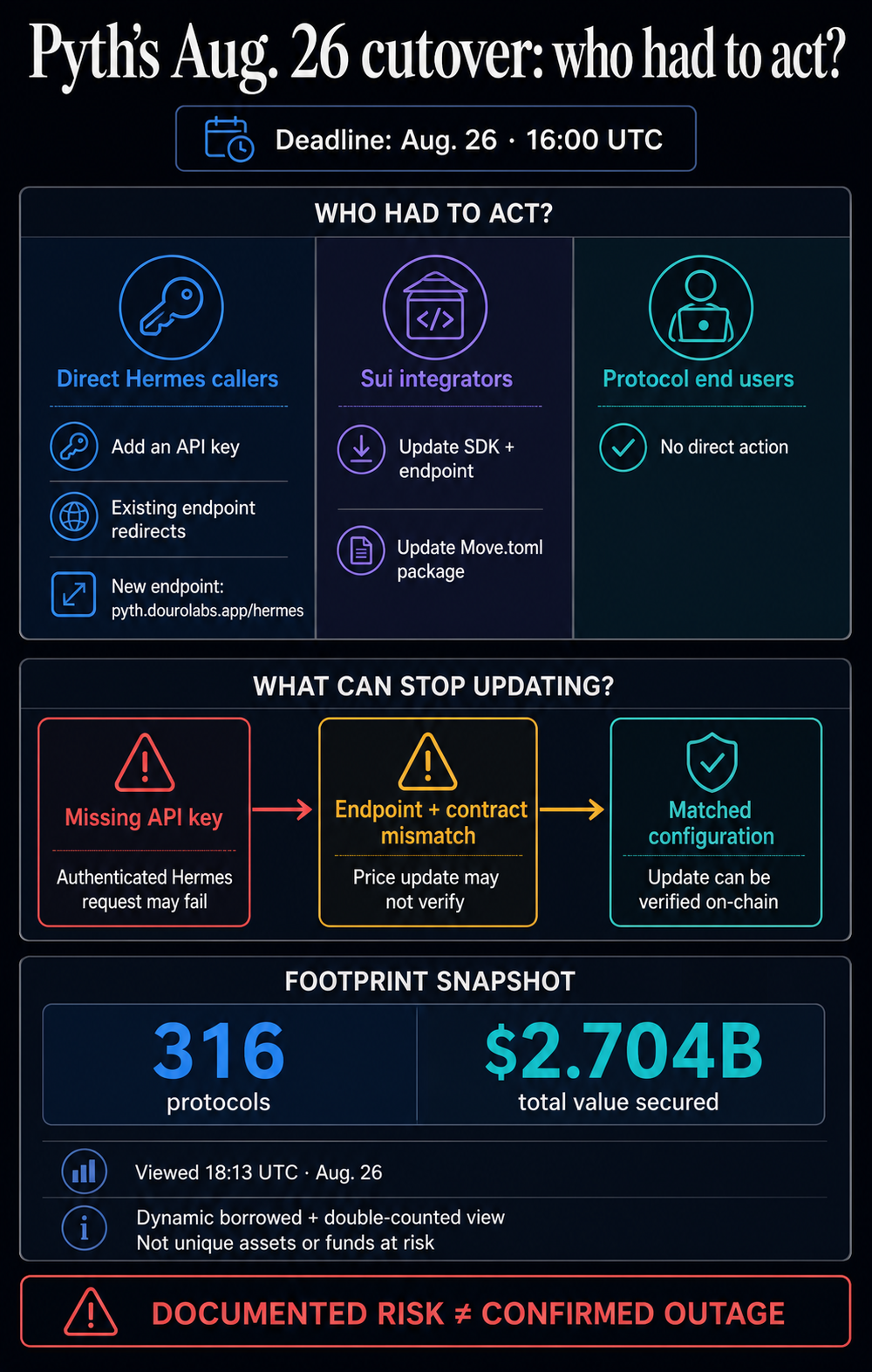
Under Pyth’s migration guide, people who use a protocol that already integrates the oracle don’t need to take direct action.
Pyth documented that the existing hermes.pyth.network address would redirect to its upgraded backend, with authentication required after the deadline. Developers could also move directly tohttps://pyth.dourolabs.app/hermes, passing the key as a bearer token or SDK access token.
Pyth said the routes and response shapes did not change.
Where incomplete Pyth migrations can fail
Pyth’s upgraded Hermes endpoint serves payloads intended for the upgraded Pyth Core contract. The guide warns that changing the endpoint without changing the contract generation, or doing the reverse, can leave an application unable to verify price updates.
An application without the required key may not complete authenticated Hermes requests, while one with mismatched endpoint and contract settings can receive data that its on-chain integration will not verify.
In a pull-oracle design, either problem can stop the application’s price-update transaction from completing until the configuration is corrected.
Sui integrations didn’t have the automatic package-swap path because applications reference the Pyth package by object ID, which the Pyth DAO couldn’t replace for them. In practical terms, Sui developers had to update both the client used to fetch price data and the on-chain Move package dependency.
Pyth’s Sui-specific guide required them to point SuiPriceServiceConnection at the upgraded Hermes endpoint with an access token and move the oracle dependency in Move.toml to the new package revision.
It also said clients whose constructor could not accept an accessToken were outdated.
A live DefiLlama oracle table mapped Pyth to 316 protocols and about $2.7 billion in total value secured.
That figure is dynamic, and the selected view includes borrowed values and settings that can count the same exposure more than once, serving as a proxy for value inside protocols that depend on Pyth.
As of that post-deadline check, there was no confirmed outage, stale-price event, loss of funds or official confirmation that every redirect and migration had completed cleanly.
The immediate test was whether direct callers could authenticate and whether their endpoint, SDK, and on-chain contract generation matched.
The post Pyth Network’s API overhaul threatens to freeze unpatched smart contracts across 300 DeFi protocols appeared first on CryptoSlate.