From the Desk of the Enterprise Ethereum Alliance (EEA)
At Agentic Finance Summit co-hosted by the EEA and Microsoft during New York Tech Week, industry pioneers convened to map the technical requirements of an entirely new economic engine.
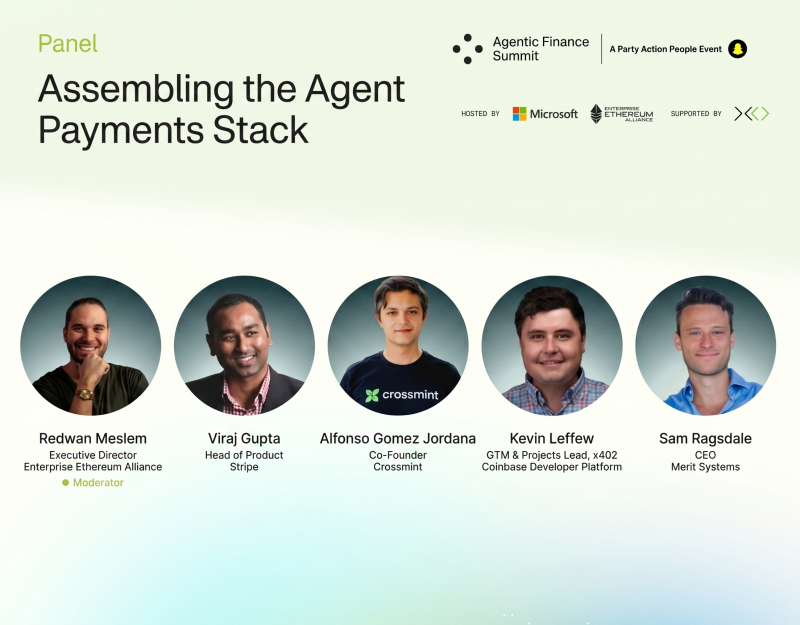
Redwan Meslem from the EEA moderated the panel, and the featured speakers included Viraj Gupta (Head of Product at Stripe), Alfonso Gomez-Jordana Mañas (Co-Founder of Crossmint), Kevin Leffew(GTM Lead and Co-Creator of x402 at Coinbase), and Sam Ragsdale (CEO & Founder of Merit Systems). The discussion moved beyond standard retail applications to confront a major architectural shift: Open agentic commerce is early, and closed-loop systems command 100x the volume today. The infrastructure to close that gap is precisely what is being built now.
The overarching theme was absolute: as autonomous software agents transition from conversational interfaces to true economic actors, enterprises require trust-minimized, open onchain standards to settle high-velocity machine payments at scale.
The Rise of Machine Payments and Micro-Transactions
The summit highlighted that the growth of artificial intelligence has fundamentally altered the structural data requirements of enterprise payment networks. Traditional corporate transactional architectures—designed around human authorization loops, graphical user interfaces, and credit card frameworks—are poorly optimized for automated software agents.
Data presented during the session underscores a massive pivot in machine-to-machine commerce: sub-dollar transactions and automated micro-payments are experiencing explosive expansion. Software agents do not transact like human consumers; they interact via programmatic calls, purchase targeted API access, and require real-time execution.
“This is something that we are seeing in our data as well, that machine payments protocol, those sub-dollar transactions, they are exploding.” — Viraj Gupta, Stripe
To satisfy this operational shift, enterprises must deploy programmatic infrastructure designed specifically for autonomous execution. Alfonso Gomez-Jordana Mañas noted that Crossmint focuses its programmatic economy stack precisely here, spanning from stablecoin issuance pipelines to dedicated agentic payment layers. For back-office corporate accounting, these high-frequency, granular fees demand a trust-minimized base layer capable of delivering deterministic, instantaneous finality.
Infrastructure Standards: Creating Value Over Value Capture
As programmatic commerce matures, several competing data frameworks are emerging—ranging from conversational commerce schemas (such as ACB and UCP) that represent checkout flows, to the Machine Payments Protocol (MPP). The panel pushed back against premature framework fragmentation, noting that sustainable enterprise adoption requires lightweight, open architectures rather than complex, proprietary vendor specs.
Kevin Leffew contextualized the role of standardization by tracking the historical precedents of web infrastructure:
“If we look at the history of standards on the web, good standards don’t capture value. They create value. They’re simple, they’re lightweight… Trust minimizing standards have won time and time again. We can see this through HTTP.” — Kevin Leffew, Coinbase
The consensus among the contributors was that complex specs must fall into the background. While conversational standards excel at routing retail payments through legacy credit systems, native digital services require programmatic infrastructure that executes seamlessly. This ensures enterprises can deploy autonomous agents that can locate, verify, and transact across borderless networks without vendor lock-in.
Overcoming Information Asymmetry and Disruption
The transition to a machine-driven economy introduces structural friction for legacy software-as-a-service (SaaS) and retail architectures. Historically, corporate margins are often a direct result of information asymmetry: relying on consumers who lack real-time market discovery or are simply too slow to find optimized offerings.
Autonomous agents eliminate this friction entirely. They optimize for the lowest commoditized pricing, instantly parse marketplace structures, and can systematically unsubscribe from inefficient software contracts. Kevin Leffew noted that agents inherently break these traditional top-down commercial models through perfectly rational economic decision-making.
Sam Ragsdale delivered a stark assessment of how abruptly this structural shift will impact legacy operations:
“I think the most interesting future here is a future of what we call open agentic commerce, which… I think it’ll be very abrupt and very painful… Agents break a lot of these models. Agents make it really easy to unsubscribe. They make it really easy to find the lowest commoditized good offering.” — Sam Ragsdale, Merit Systems
While digitally native services are seeing immediate traction due to direct user-experience optimization, physical e-commerce will likely evolve into a hybrid model. Major centralized marketplaces will continue to co-exist with standalone enterprise environments. Bridging the gap between today’s dominant closed-loop systems and an open agentic marketplace requires interoperable infrastructure that natively links enterprise data pipelines to public onchain settlement rails.
Key Takeaways
- Architect for Machine Capital: Prepare internal corporate payment architectures to ingest and settle high-velocity, sub-dollar machine transactions, moving past human-gated credit card loops.
- Prioritize Lightweight Open Standards: Evaluate emerging agentic commerce protocols based on their simplicity and trust-minimization to prevent enterprise vendor lock-in.
- Review Margin Defensibility: Recognize that autonomous agents remove market information asymmetry, making real-time price optimization and operational transparency essential to protect revenue.
- Prepare for Abrupt SaaS Disruption: Transition legacy subscription and software distribution channels toward open, interoperable onchain environments to buffer against sudden automated market rebalancing.
The Enterprise Ethereum Alliance provides the neutral convening layer where global enterprises, regulators, and infrastructure teams coordinate to build production-grade standards. Contact us to join our working groups and shape the future of institutional Ethereum.
The post Agentic Finance Summit: Insights on Machine Payments and the Onchain Stack appeared first on Enterprise Ethereum Alliance.