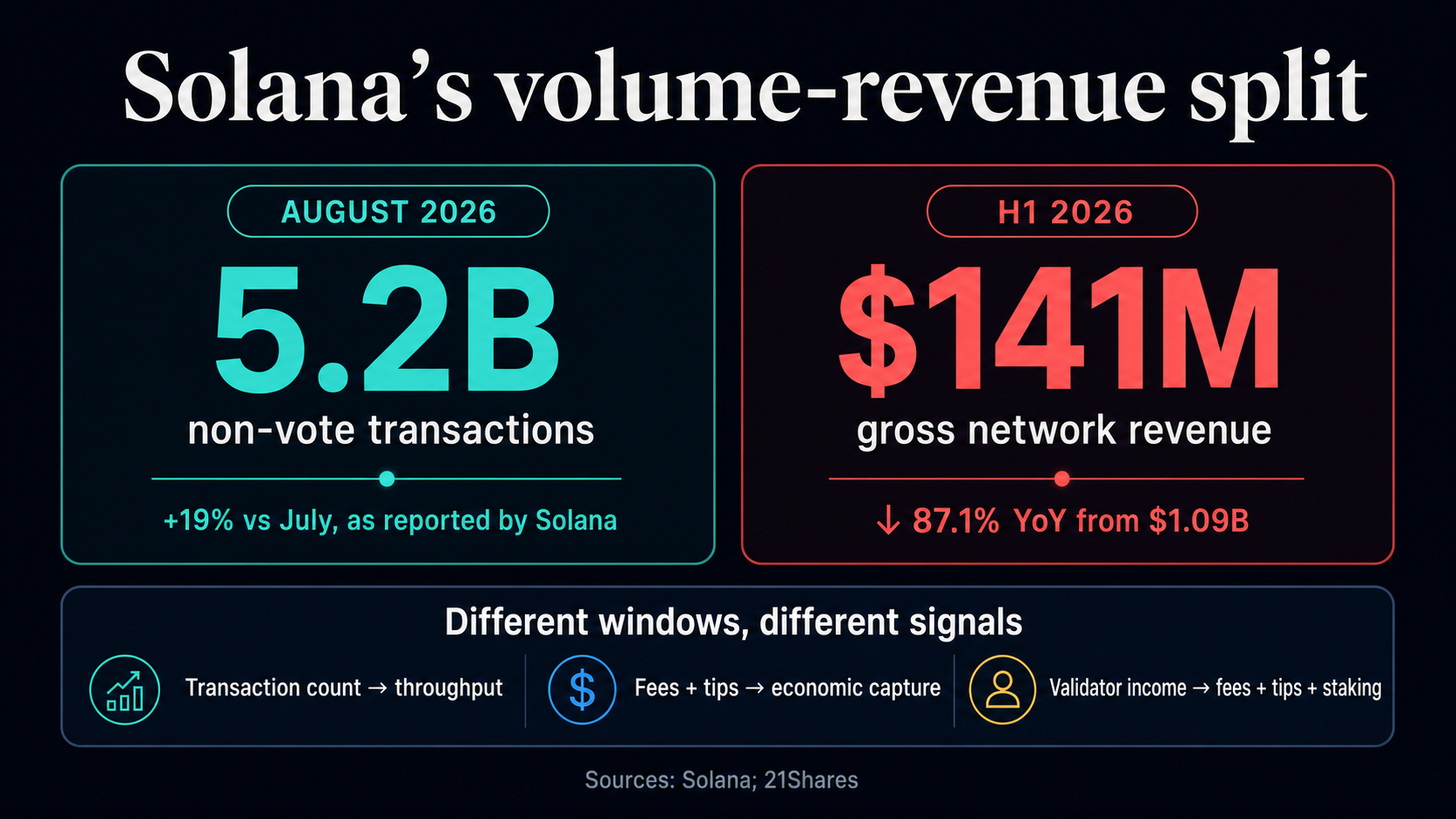
Solana says it processed a record 5.2 billion non-vote transactions in August, a total it described as 19% above July.
The milestone arrived with a sharply different measure: 21Shares calculated that gross network revenue, including fees and tips generated by network use, fell to $141 million in the first half of 2026 from $1.09 billion a year earlier.
The figures cover different periods. The transaction count captures the month ended Aug. 31, while the revenue comparison covers the six months through June. Together, they show activity accelerating after a half-year in which Solana generated far less fee and tip revenue than during the memecoin boom a year earlier.
Why Solana’s activity and revenue diverged
Non-vote transactions remove validators’ consensus messages from the count, giving a cleaner view of application activity. The metric can still include successful and failed transactions, and it measures neither unique users nor value transferred. Identifying transfers, trades and other actions requires program-level analysis, according to documentation from Dune and Token Terminal.
21Shares traced the revenue decline to weaker competition for blockspace. It said priority fees and Jito tips, extra payments routed through Solana’s transaction-ordering infrastructure, produced 95% of H1 2025 gross revenue, split 40% and 55%. Memecoin traders paid those charges to move ahead in crowded blocks; that high-value fee stream contracted as the frenzy cooled.
The trading mix changed as well. The firm said memecoins fell from 40% of Solana spot trading volume in H1 2025 to 16% in H1 2026, while stablecoin swaps rose from 6% to 19%. 21Shares said the categories replacing memecoins generated less revenue per trade.
A like-for-like quarterly comparison supports the same trend. A DeFi Development Corp. shareholder letter filed with the SEC put Solana’s Q2 network revenue at $51 million, down 43% from the first quarter and 81% year over year, while the median transaction fee was $0.00043.
Shorter-term validator fee data improved by late August. Solana Compass reported that a seven-day average reached about 9,200 SOL per day, more than 80% above three months earlier. That SOL-denominated figure includes priority fees and Jito tips, while the 21Shares measure covers six-month gross revenue in dollars, leaving the two unsuitable for direct comparison.
Validator economics extend beyond those charges. Under Solana’s fee rules, half of the base fee goes to the block producer and half is burned, while the full priority fee goes to the validator. Validators can also earn commissions on inflationary staking rewards.
For SOL, the throughput record is operationally positive. Economic capture still depends on what users pay for blockspace, how much SOL is burned or staked, and whether rising stablecoin, DeFi and payment activity produces durable fees. Transaction count alone remains a weak proxy for validator income or token demand.
The post Solana processed 5.2 billion transactions after revenue collapsed 87% – here’s what changed appeared first on CryptoSlate.